


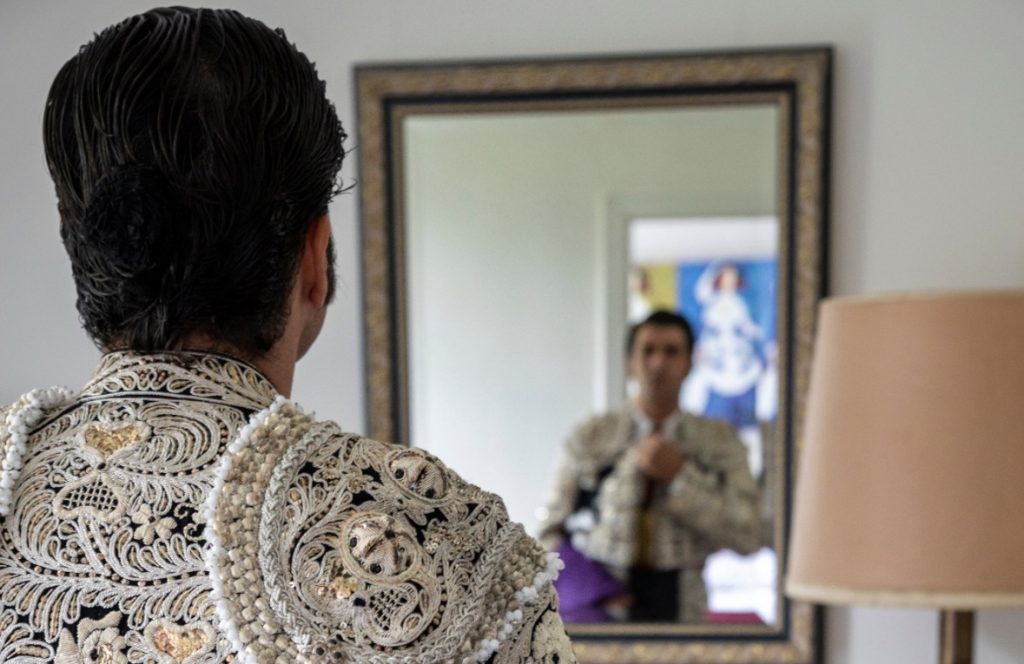
José Antonio Morante, the world’s greatest torero, needs a suitcase of medication to ease his struggles with depersonalisation disorder and agoraphobia.
Por Martha González de la Peña.
An hour before facing his first bull of the afternoon, the world’s greatest torero struggles in his hotel room with an implacable foe: himself.
José Antonio Morante de la Puebla feels terror before a bullfight, he says, but it is his mental health problems that paralyse him with fear.
“I’m fighting against an illness, a dissociative disorder that is not letting me live. So I have to fight against this and the bull. I have to fight against it all,” he tells The Times. It is a fight, he adds, against “these personalities, the bulls and me”.
Morante has undergone various pharmacological treatments and even received electroshock sessions
Which is worse, the bulls or the illness?
“The illness,” he replies, his voice barely audible above the hum of traffic below.
The interview takes place before Morante dresses for a corrida in Azpeitia, a small town in the Basque region in northern Spain. His traje de luces, suit of lights, hangs over a chair in a corner. He sits at a small table, wearing a bath towel around his waist, in front of an ashtray brimming with cigarette butts.
An air of doleful resignation hangs over him as he chain smokes. His face appears slightly puffy, perhaps a side-effect of the “suitcase of medicine I have to lug about”. The opposite of a brash showman, Morante speaks thoughtfully and slowly. His illness caused him to suddenly break off from the bullfighting season two months ago.
Morante, 44, has suffered for more than two decades from depersonalisation disorder and agoraphobia — which causes myalgia, headaches and strong attacks of uncontrolled crying, as well as confusion and disorientation. He has undergone various pharmacological treatments and even received electroshock sessions in 2004.
The last attack, however, gave him weak legs and left him without strength. “It hit me harder than before,” he says, lighting another cigarette before taking a sip of coffee.
At the end of July he resumed bullfighting to great acclaim. “The genius returned and the world began to dream,” stated the newspaper ABC. “We smiled at his bullfighting, although at the same time it hurt to see the broken soul of a man, so full of feeling … a bullfighting born to mark an epoch and which will die when his last bull is dragged away.”

Beloved of purists for his classical, understated style, for several years bullfighting critics have debated whether Morante is the best of all time or simply of his time. Faced with the left-wing government’s opposition to its “cruelty”, its decreasing popularity and a dearth of top-class matadors, the tradition “needs Morante”, wrote Antonio Lorca, the bullfighting correspondent of El Pais.
But many wonder if he will even reach the end of the season in September. “I try to ensure that the pressure doesn’t dominate me because I know there are a lot of people who want me to bullfight but they also want me to bullfight feeling well,” he says. “At times I can mask that pressure … I am continuing with treatment but with a lot of anguish.” A pause. “In truth, I suffer a lot.”
Doctors have told him that keeping on bullfighting is helping him with his mental health. “It’s not easy to say if that’s right, but the doctors have put a lot of emphasis that I should continue bullfighting, doing my profession, and that this will gradually go away,” he says, before adding with a chuckle: “They are hopeful but me … not so much.”
The solitude of the bullfighter has often been described. His illness has compounded his sense of isolation. “I feel very alone, even with the doctor,” he says. “I don’t feel like a special patient as regards all the other sufferers but this is a profession that is different to all others. From there comes also the uncertainty of ever escaping this at last.”
His recent bout of illness prompted some commentators to say that he had opened a debate about bullfighters’ mental health. However, he does not see himself as an ambassador for it. “Each head is its own world,” he says. “I don’t know any other bullfighters who are going through the same thing as me.”
Does the illness stem from the hardship of bullfighting?
“I was 21 when it suddenly hit me and without knowing why,” he says. “There is nothing that can be linked to it for sure.” He laughs again: “There is no trauma even though you could say that appearing before a bull is a trauma.”
Morante dispatches questions about the gorings he has received over the years with modesty. “I have been lucky, a few incidents but the consequences have not been worse than the scars,” he says.
The hour is nearing when he must face a bull again. He begins to don the intricate outfit of the bullfighter, with the help of Juan Carlos, his cousin, with whom he grew up as neighbours in the town of La Puebla near the southern city of Seville.
The costume, with its cotton undergarment and delicate ties, is at odds with the bloody task confronting its wearer. Morante no longer indulges in elaborate pre-fight rituals that some toreros hope bring good luck. But he has faith. “Bullfighters are not great for going to Mass. Each one has his own personal faith,” he says. “I believe it helps to keep going when one feels one can’t, to implore to the altisimo (Almighty) that he helps you and he does.”
Dressed, he casts a look in the mirror to practice a few bullfighter’s flourishes with his hand and sets off for the plaza de toros.
It is like a Goya scene, a small bullring packed with Spaniards in festive mood. Morante and two other toreros dispatch the six bulls to jubilant waving of white handkerchiefs and are carried aloft on shoulders from the ring.

Azpeitia is an unusual enclave of bullfighting in a Basque nationalist heartland. Morante presents an equally unexpected sight: a sorrowful figure in a “suit of lights”. Before heading to fight the bulls he said such victories only grant him a reprieve of minutes before the loneliness of his illness returns. He agreed to give the interview, he added, in the hope that somebody will come forward with a solution that helps him.
Is there any place where he feels at ease?
“These days, in truth, nowhere,” he said. “There is no place.”
Source: The Times.

Deja un comentario