


I predict that there will be an even bigger crowd on Oct. 18 and at the November corridas.
By Morgan Smith.
“Look out. You’re going to get your self killed,” the security guards yelled as we scrambled over the coupling between the railroad cars.
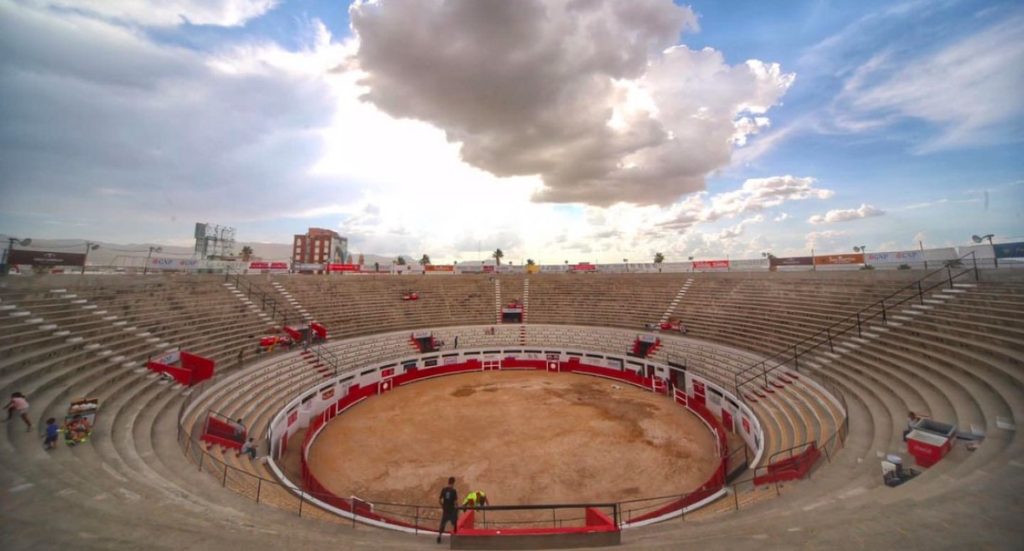
It was 7 p.m. on Oc. 4 in Juárez an enormous train had stopped in the middle of Francisco Villa Street, between the Avenida Benito Juárez where the restaurants are and the Plaza de Toros Alberto Balderas. Those dozens of us who had tickets for this first corrida in many years were blocked by the train. Juárez is still a dangerous city, but this was the only danger we faced.
The Plaza de Toros is now under new management and this was to be its first test. I have seen many corridas there but the last one was in 2019. In this case, there will be additional corridas Oct. 18 plus Nov. 3 and 17, featuring not only top Mexican bullfighters but also leading Spaniards like Antonio Ferrera on Oct. 18, Andy Cartagena, the excellent rejoneador, someone who fights bulls from horseback, on Nov. 3, and the legendary Pablo Hermoso de Mendoza, perhaps the greatest rejoneador of all time on Nov. 17. This fight will be part of his retirement tour.
The Plaza was about three quarters full and we were able to see three excellent young Mexican matadors. There were some glitches. At one point, the lights went off, leaving a matador and his team in the dark rink with a highly dangerous bull. Later, a water hose broke, flooding part of the arena. But these were just incidentals for the enthusiastic and hard drinking crowd.
Unlike bullfights in Spain, here there is an endless procession of vendors, men and women, hauling huge buckets of beer, offering taco chips with some sauce I haven’t the nerve to try, selling cigars and other treats.
The matadors were Ernesto Javier, “El Calita,”; Leo Valadez, 27, from Aguascalientes; and Diego San Román, 30, from Querétero. He learned bullfighting from his father, Oscar San Román, who was also a bullfighter.

Calita fought first and earned an ear on his first bull. Valadez, who had been fighting in Spain until he injured his shoulder in Madrid last May, came next and his first bull received an indulto, or pardon, because of its bravery. Diego San Román earned two ears on his second bull with perhaps the most spectacular performance of the evening.

The crowd loved it and the short temporada, or season, is off to a good start. I predict that there will be an even bigger crowd on Oct. 18 and at the November corridas. However, this was also a chance to see Juárez at night, something I generally try to avoid.
Here are some reactions.
For a city that is ranked as one of the most dangerous in the world, Juárez seemed perfectly safe given the number of people – men, women and also many families with little kids – on the streets.
We went to the famous Kentucky Club for dinner and it was packed. Mediocre food and too much noise. I don’t recommend it.
We also took several long taxi rides to our hotel, the Comfort Inn, and both drivers stressed how safe they felt.
It’s encouraging that the residents of this proud city feel they can be out at night and enjoy themselves. We plan to go again on Nov. 18. Perhas by then the train will have moved.
Source: El Paso Inc.
Morgan Smith travels to the border at least once a month to document conditions and assist humanitarian organizations. He can be reached at morgan-smith@comcast.net.


Deja un comentario